Object-centric contact prediction
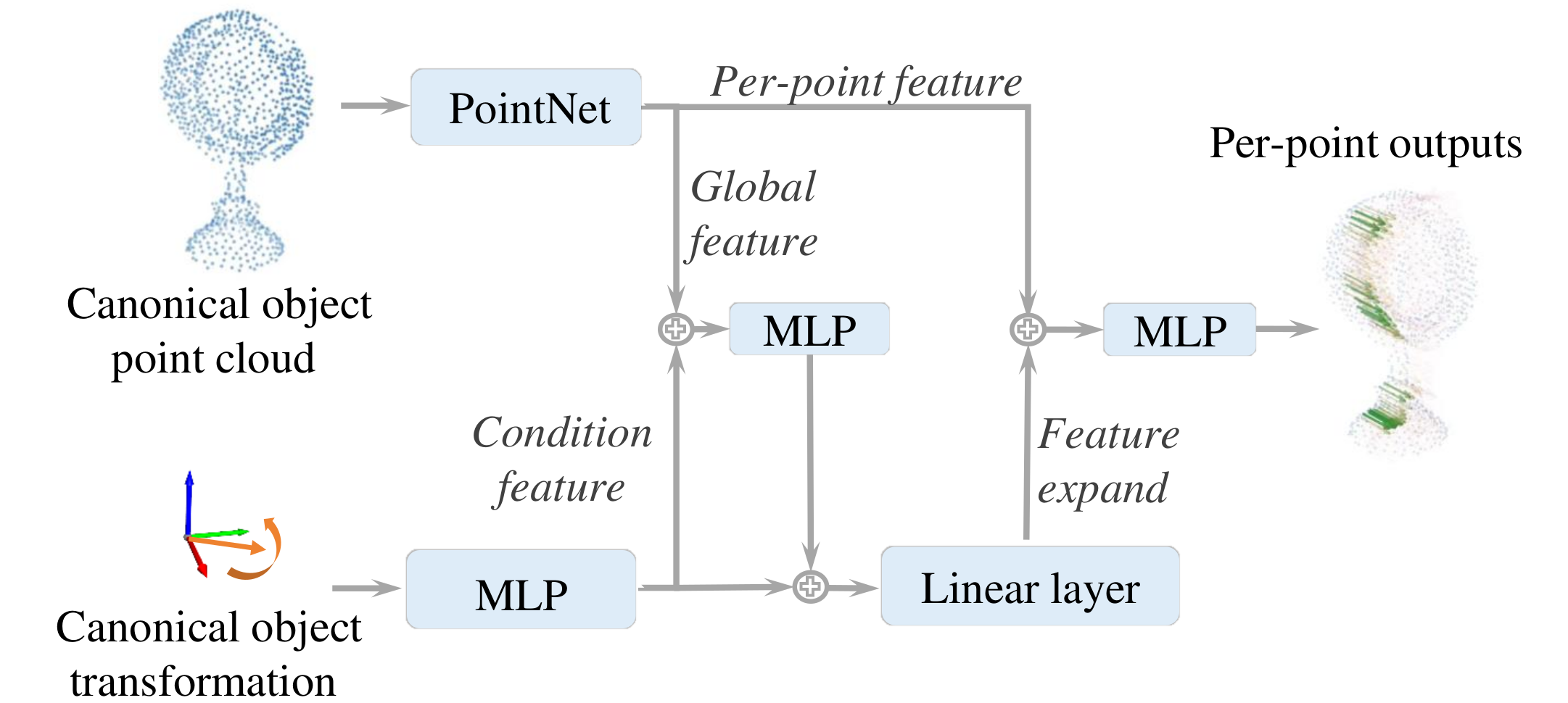
The policy consumes a canonical point cloud and a desired single-step transform, then predicts contact probability, push direction, and push distance densely over the object surface.
National University of Singapore Shanghai Innovation Institute
† Corresponding author
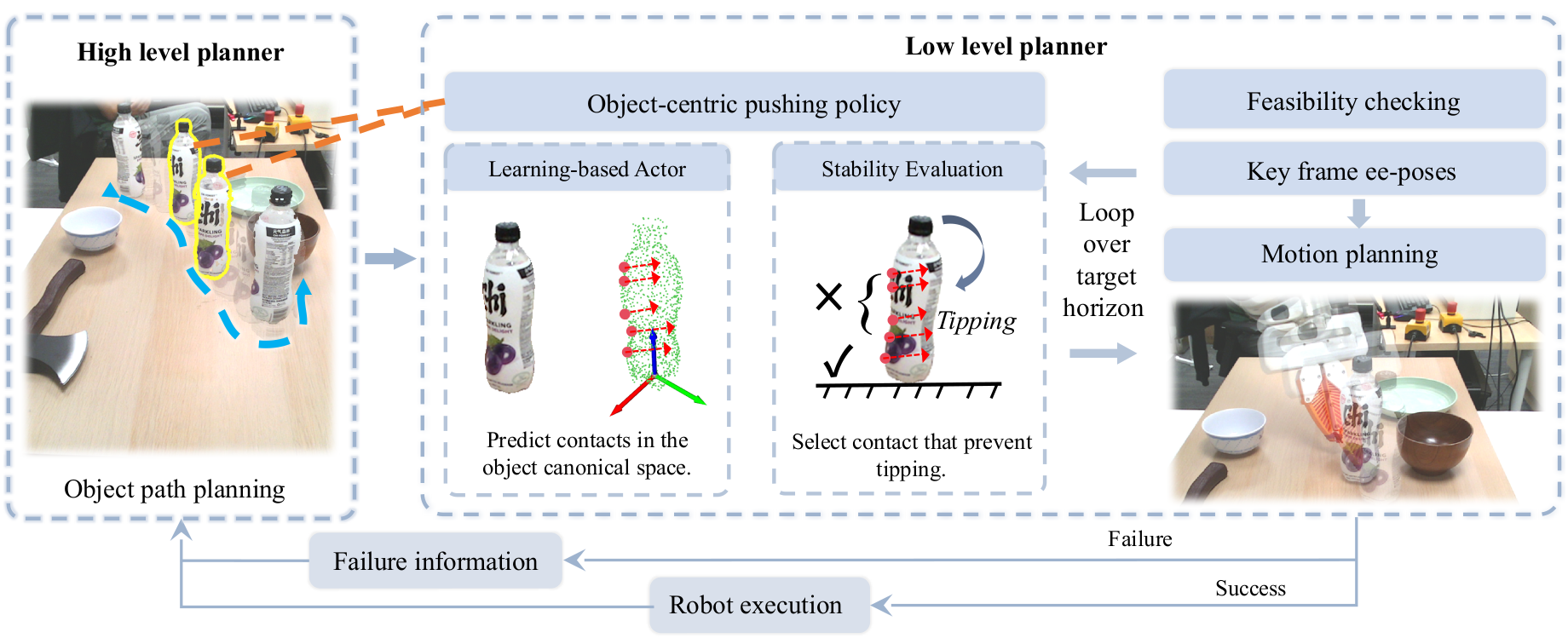
Non-prehensile manipulation is practical for re-locating large, heavy, or geometrically ungraspable objects. Yet, long-horizon pushing of arbitrarily-shaped 3D objects couples three problems: 1) where to push the object so as to approach the target pose, 2) whether each push is stable and reachable, 3) whether subsequent actions remain feasible. We present an object-centric pushing policy within a feedback-guided hierarchical framework. At the low level, a learning-based policy predicts contact actions from a pose- and scale- normalized point cloud, conditioned on a near single-step subgoal. A stability score is applied to evaluate the predicted contacts by a quasi-static sliding-versus-tipping analysis. At the high level, BIT∗ first searches for an object path, and the next several subgoals are checked by contact prediction and robot motion planning for future feasibility. Failed motion plans, as feedback, change the local path costs and trigger re-planning. During execution, only the first feasible action is executed. In simulation, we evaluate 22 objects in six different scenes, upon which we also conduct comprehensive ablation studies. Results demonstrate that our method outperforms baselines with a clear margin and can reliably achieve long-horizon object pushing tasks under different situations. We also report quantitative real-robot experiments with a Franka arm and qualitative demonstrations with a mobile manipulator for large and heavy objects, with directly zero-shot sim-to-real transfer.
The policy consumes a canonical point cloud and a desired single-step transform, then predicts contact probability, push direction, and push distance densely over the object surface.
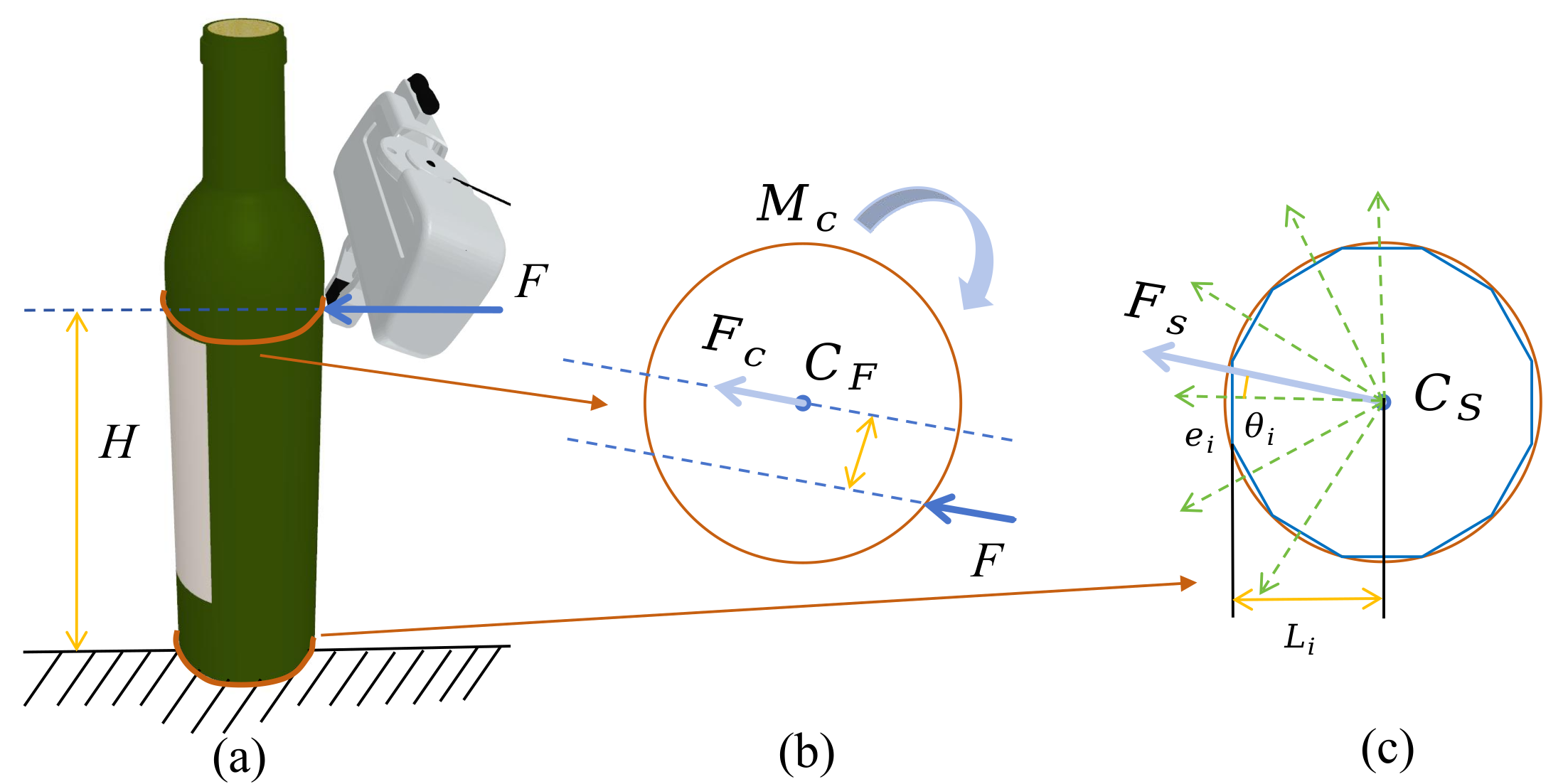
A quasi-static analysis compares the force required for sliding with the force that would tip the object around its support polygon, providing an explicit and scale-invariant ranking cue.
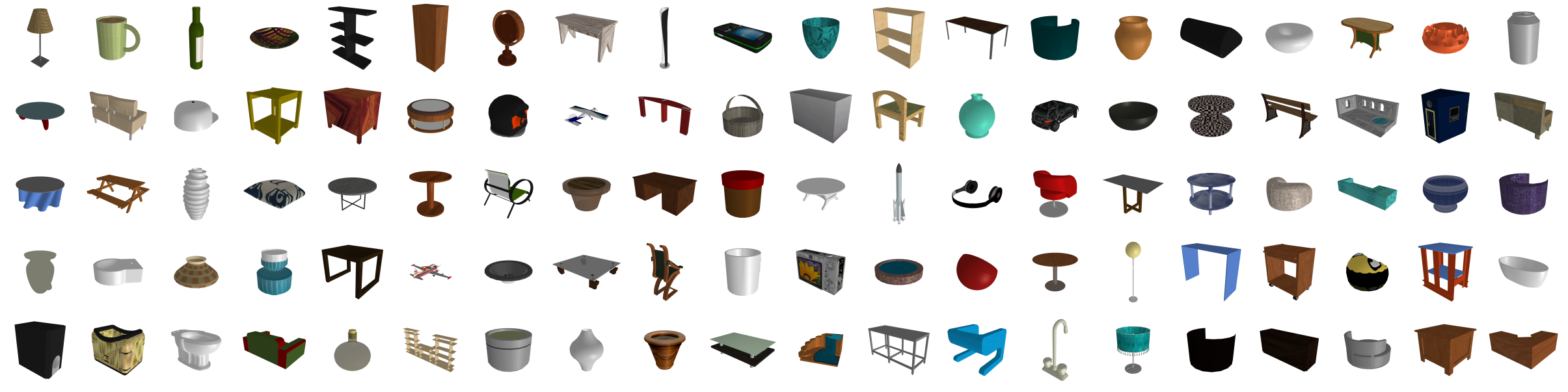
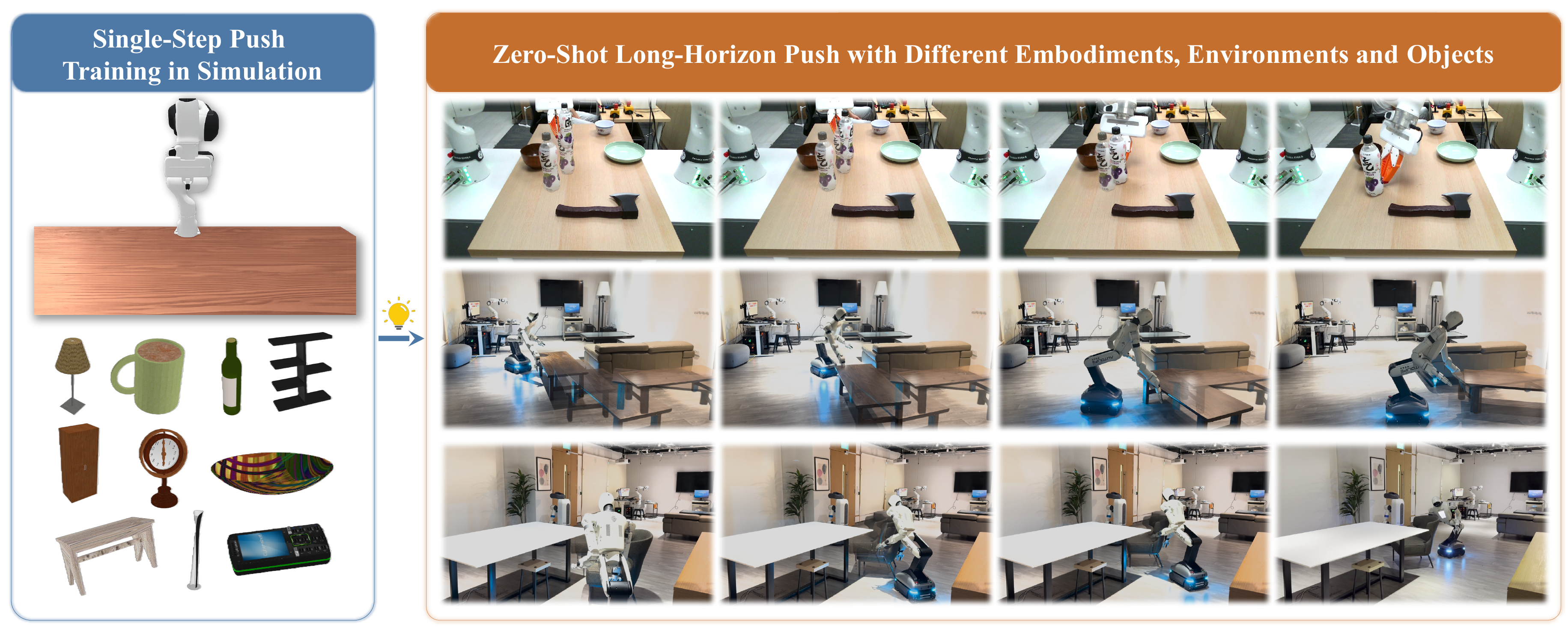
Training data are collected entirely in simulation. Each rollout uses one fixed push direction; canonicalization and point-wise prediction turn these local examples into a policy that transfers across pose and scale.
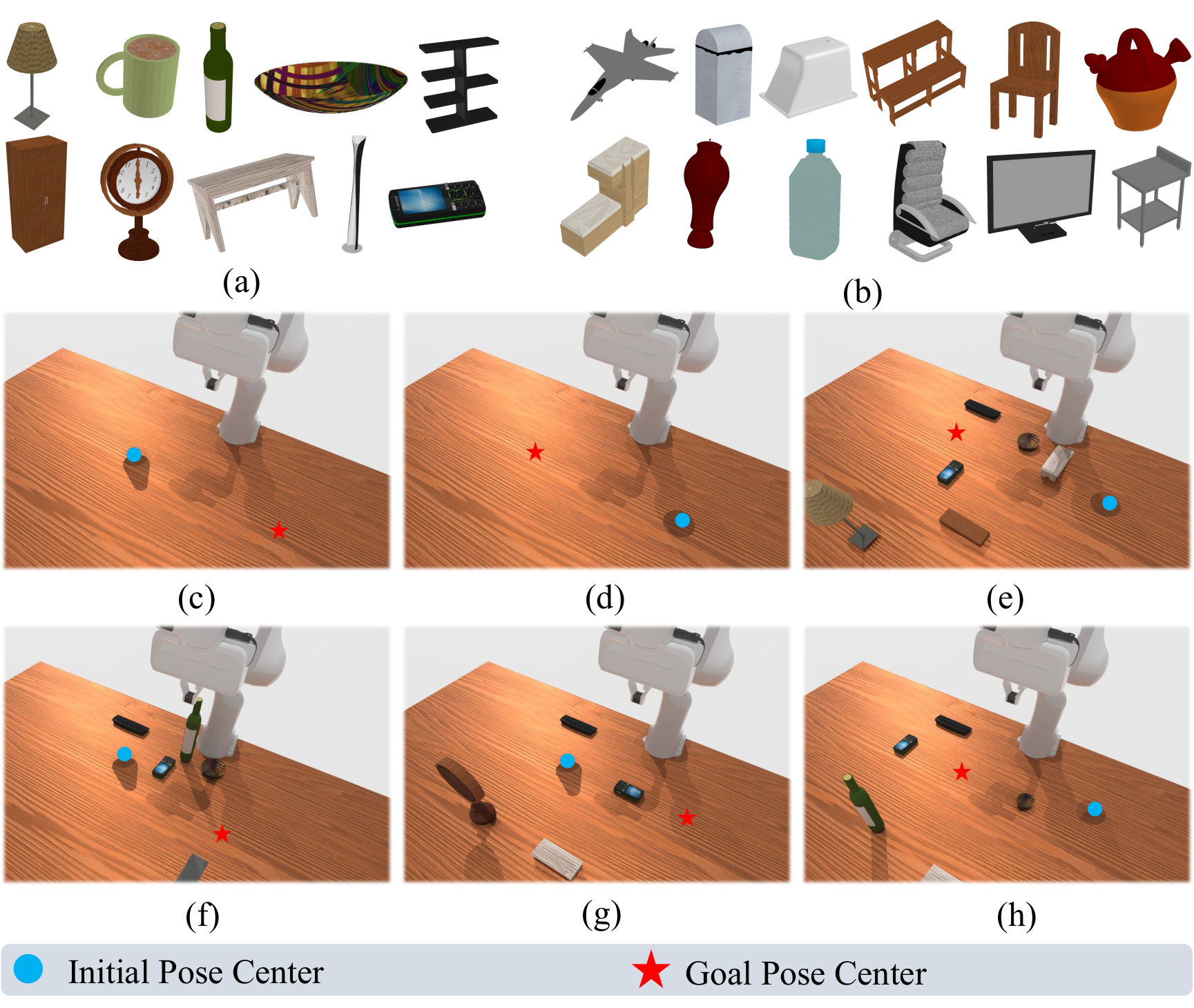
22 objects
6 scenes
6,600 trials per method
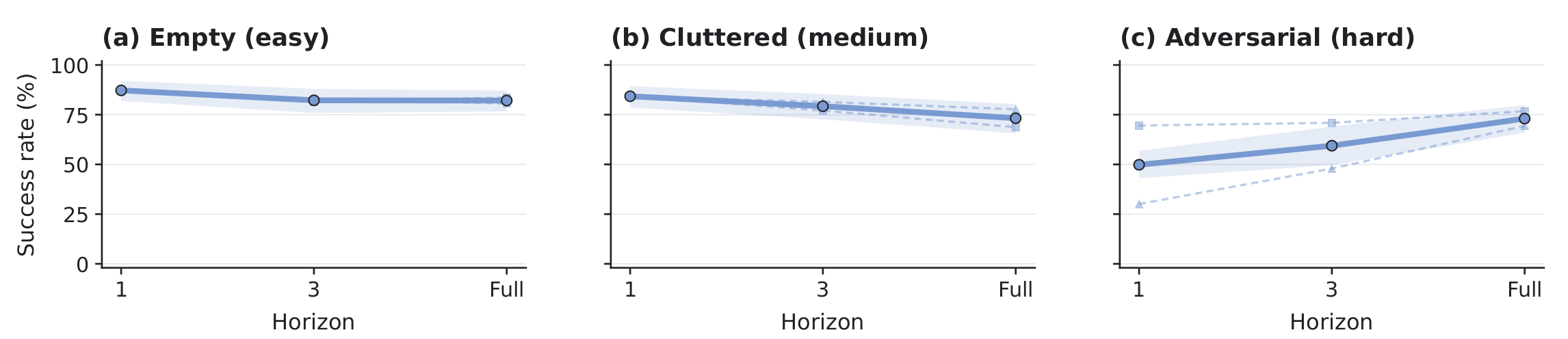
Short-horizon planning performs best in empty and ordinary clutter, where long rollouts accumulate model error. In adversarial scenes with tempting but ultimately infeasible paths, full-horizon checking raises success from 49.82% to 73.05%.
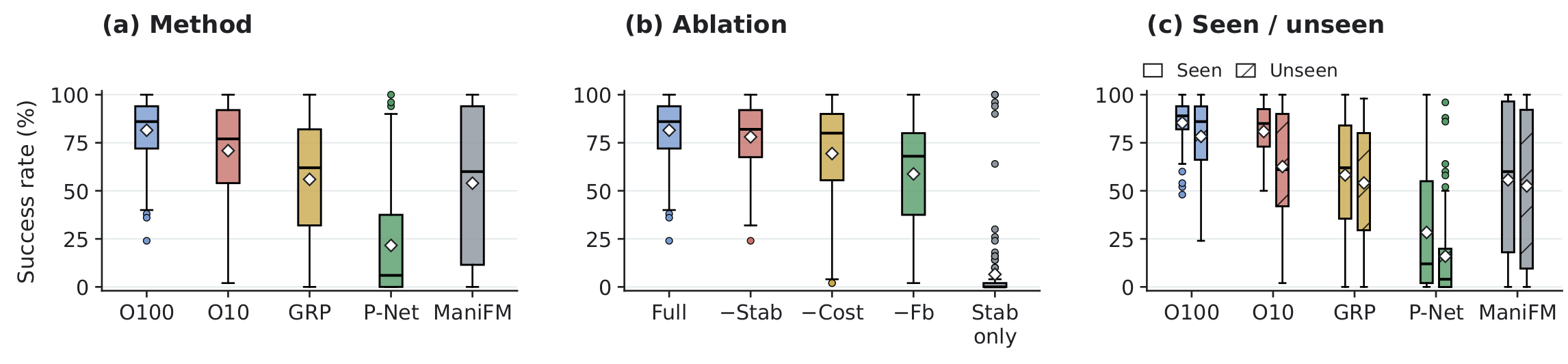
Ours-100 reaches 81.52% overall success and 78.31% on unseen objects, with no zero-success object-scene pair. Increasing training diversity improves unseen-object success by 15.70 percentage points over Ours-10.
| Method | All objects | Seen | Unseen |
|---|---|---|---|
| Ours-100 | 81.52% | 85.37% | 78.31% |
| Ours-10 | 70.89% | 80.83% | 62.61% |
| Greedy Reactive Policy | 55.97% | 58.23% | 54.08% |
| Push-Net | 21.59% | 28.33% | 15.97% |
| ManiFoundation | 53.95% | 55.70% | 52.50% |
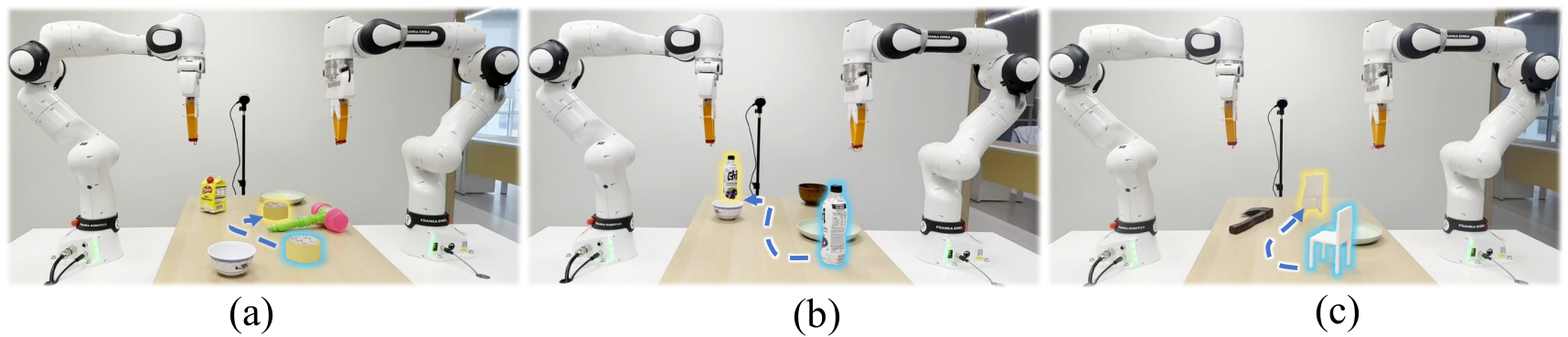
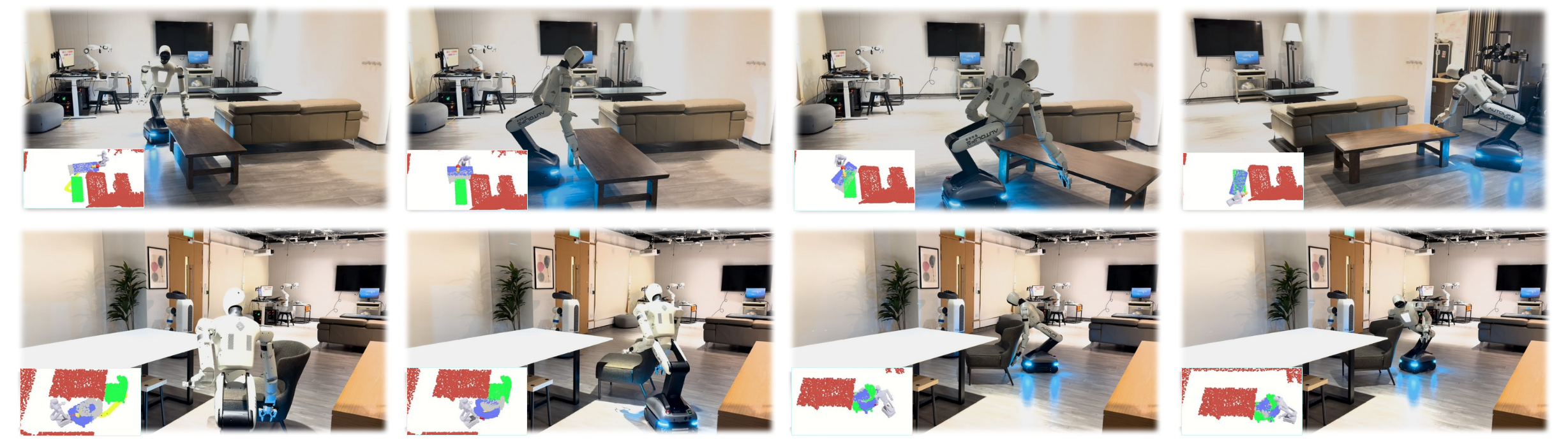
Our method directly transfers zero-shot to both dual-arm tabletop manipulation and mobile-robot furniture rearrangement.
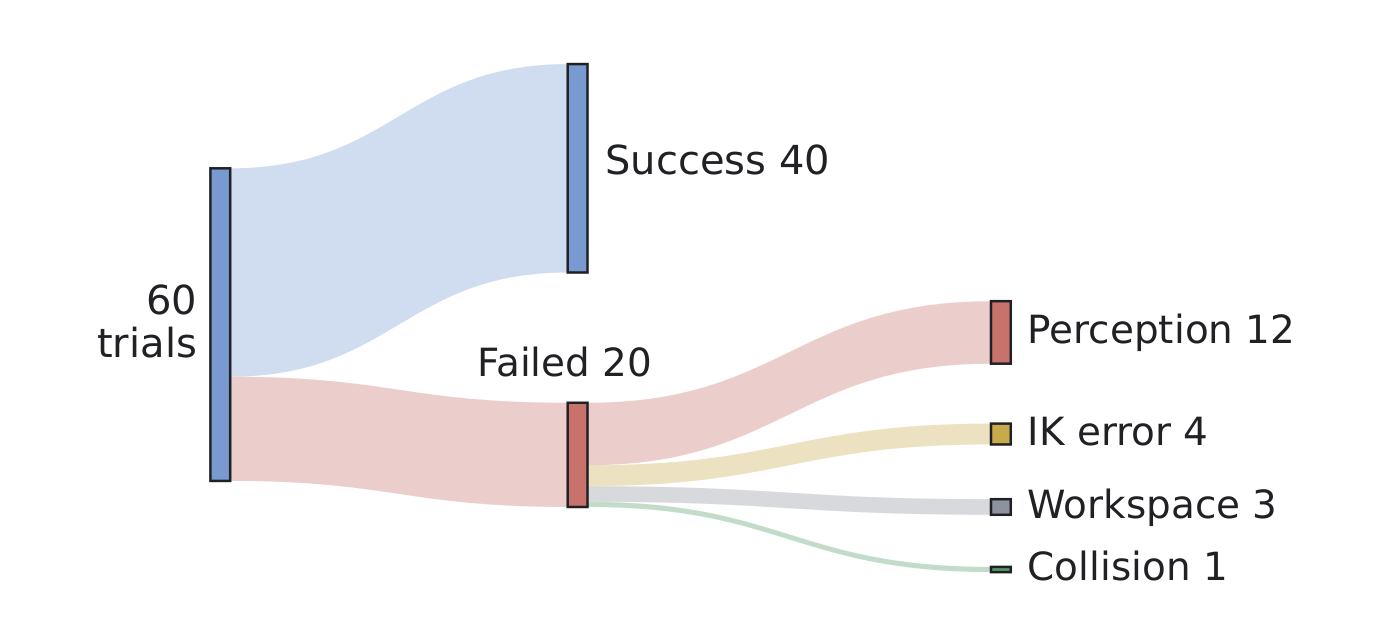
Of the 20 unsuccessful tabletop trials, 12 are attributed to perception. The remaining failures come from infeasible inverse kinematics, leaving the workspace, or collision. This points to reconstruction and pose tracking as the most direct opportunities for improvement.
@misc{yuan2026recedinghorizonpushingcomposableobjectcentric,
title={Receding-Horizon Pushing with Composable Object-Centric Policies},
author={Zhiyi Yuan and Tianrun Hu and Anxing Xiao and Yuhong Deng and David Hsu and Hanbo Zhang},
year={2026},
eprint={2609.23439},
archivePrefix={arXiv},
primaryClass={cs.RO},
url={https://arxiv.org/abs/2609.23439},
}